I’m Steve Bossard, a New York State licensed home inspector serving Ithaca and nearby Finger Lakes communities. Local properties vary: some are on relatively level ground, while others have changing grades or complex relationships between house, driveway and yard. I look at visible, accessible evidence and explain how those pieces fit together. The aim is not to presume a problem, but to give you a grounded picture of this property and sensible questions to consider.
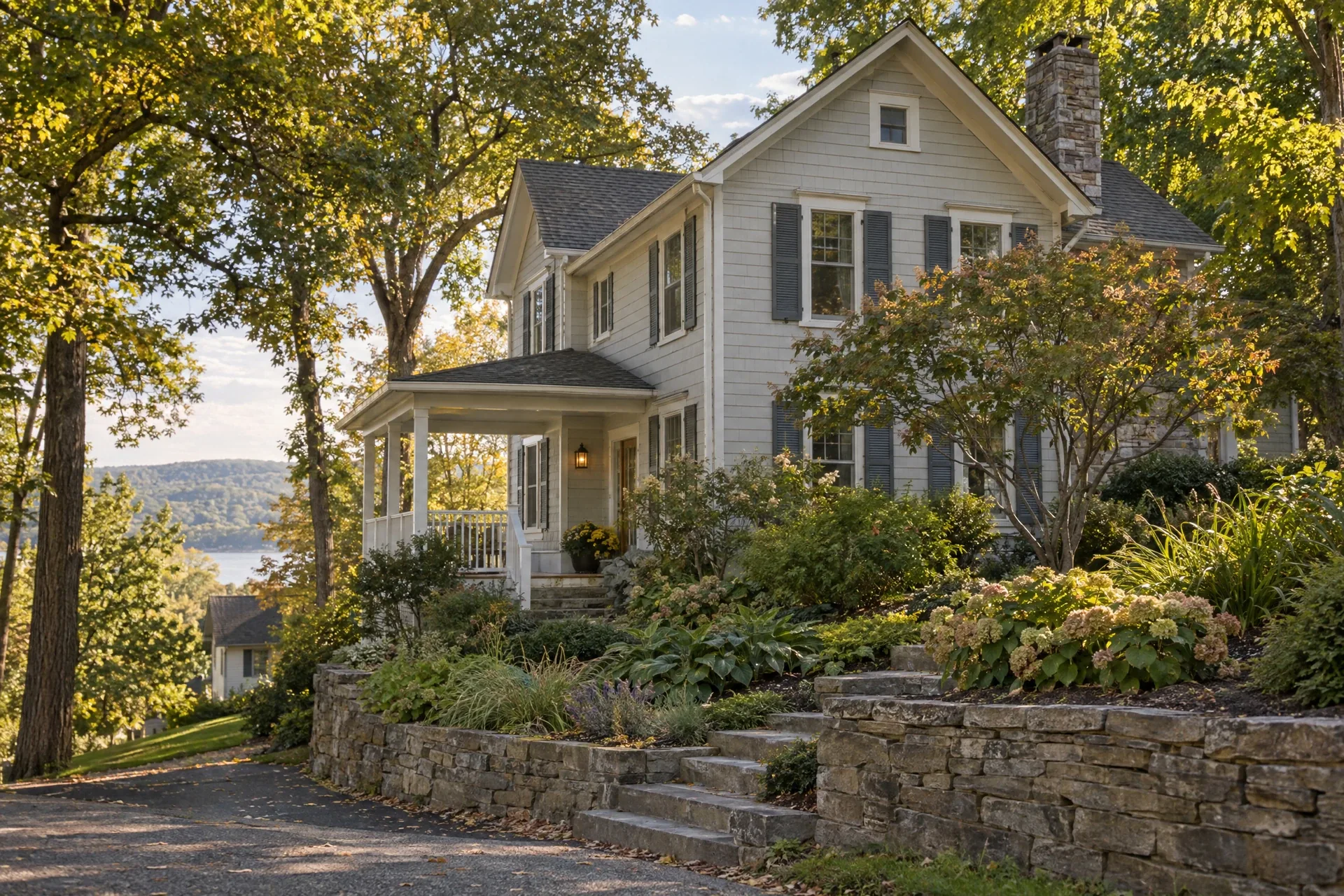
Representative traditional hillside home with terraced planting and a stone garden edge.
Site and drainage
Review visible grading, runoff paths and retaining features.
House systems
Consider foundations, renovations, roof areas and attic ventilation.
Useful reporting
Get photos, plain explanations and priorities for follow-up.
Read the site as well as the house
On a sloping or irregular lot, I consider visible grade, roof runoff, and whether paving or landscaping directs water toward the building. Retaining walls, driveways and neighboring grades can alter its route. These are observations, not a prediction that the site will flood.
I note clues such as downspouts near the house, ponding, erosion or soil against siding. Weather matters, and buried drains or concealed grading are beyond a visual review. If the pattern is unclear, I’ll describe what I saw and suggest a focused question for the owner or a drainage professional.
Connect drainage to foundation observations
In accessible basements or crawlspaces, I look at visible foundation surfaces and clues such as staining, efflorescence, damp materials or patching. A mark can have several explanations; I don’t label every discoloration active leakage or diagnose hidden conditions.
Near retaining features, visible movement, cracking or drainage openings may merit attention, though appearance alone cannot establish structural capacity. I’ll explain when specialist evaluation may help. A dry inspection day cannot prove a basement will stay dry; ask about prior water events and repairs.
Put older work and renovations in context
Ithaca homes have varied ages and histories, and some have been updated in stages. I look at accessible places where additions, finished rooms or remodeled areas meet older construction. Uneven floors, patched finishes or altered framing can prompt questions, but don’t prove improper work.
When history matters, ask the seller for available plans, permits, invoices or repair details. An inspection is not a permit or code-compliance review, and I can’t assess hidden work without access. I’ll state limits and suggest targeted evaluation when appropriate.
Look up to the roof and attic
Roof surfaces, gutters and downspouts connect to attic conditions in the home’s water-management picture. If safely accessible, I look at visible framing, sheathing, insulation, ventilation openings and signs of moisture or past leakage. Stored items or finished ceilings may limit visibility.
Ventilation should be considered with insulation, roof design and moisture clues; adding vents is not automatically the answer. I don’t design ventilation or inspect covered areas. If warranted, ask a roofer or insulation professional to assess the assembly and clarify reported repairs.
Use the report to set sensible priorities
An inspection is a noninvasive review of visible, accessible systems, not a pass-or-fail verdict or guarantee against hidden defects. My digital report uses full-color photos and plain explanations to identify concerns, priorities, maintenance and possible further evaluation.
Buyers can use findings to inform questions with their advisers; I don’t decide whether to buy or negotiate. Sellers can understand visible conditions before considering maintenance or listing plans. Radon testing, water testing, and thermal imaging may suit specific questions, each with preparation, testing, or access limits; we can discuss the appropriate scope beforehand.
Prepare for a more informative visit
Share what you know about water entry, drainage work, foundation repairs, roof leaks or renovations, and provide records if available. Clear access to the electrical panel, attic hatch, basement or crawlspace helps me inspect safely reachable areas. I don’t move heavy storage or dismantle finishes.
Point out a slope, retaining wall, basement corner or attic area of concern. Weather and layout affect conditions, so an inspection is a snapshot, not continuous monitoring. Use the report to ask focused questions of the seller or relevant professionals; I explain evidence and limits to help you decide next steps.
Before we take a closer look
Questions worth asking.
Does every Ithaca home have a steep lot or water problem?
No. Lots and buildings vary, and a slope is not automatically defective. I assess visible grading and water-related clues at the property rather than assuming a problem from its location.
Can an inspection confirm that a basement will stay dry?
No. I report accessible conditions and visible signs on inspection day, but concealed drainage, weather and maintenance affect performance. Ask about past water events and seek specialist evaluation when warranted.
Should I provide renovation or drainage records?
Yes, if available. Plans, permits, invoices or repair details can frame questions, but reviewing them is not a compliance audit or an evaluation of concealed work.
The right scope for your home
Local knowledge.
A closer look.
Different services answer different questions. Choose the investigation around the property—not the other way around.
Your next step
Let’s talk about your home.
If you’re considering a home in Ithaca, I’m glad to discuss the property and the questions you want an inspection to answer.