Choose the extra inspection that answers your question
A home inspection gives you a broad look at visible, accessible systems; it does not answer every question about indoor air, water quality, or surface-temperature differences. I offer radon testing, water testing, and thermal imaging as focused services to consider alongside an inspection. The right choice depends on the property and your decision. You may not need every add-on; choose tests for a reason, with a clear understanding of their preparation, results, and limits.
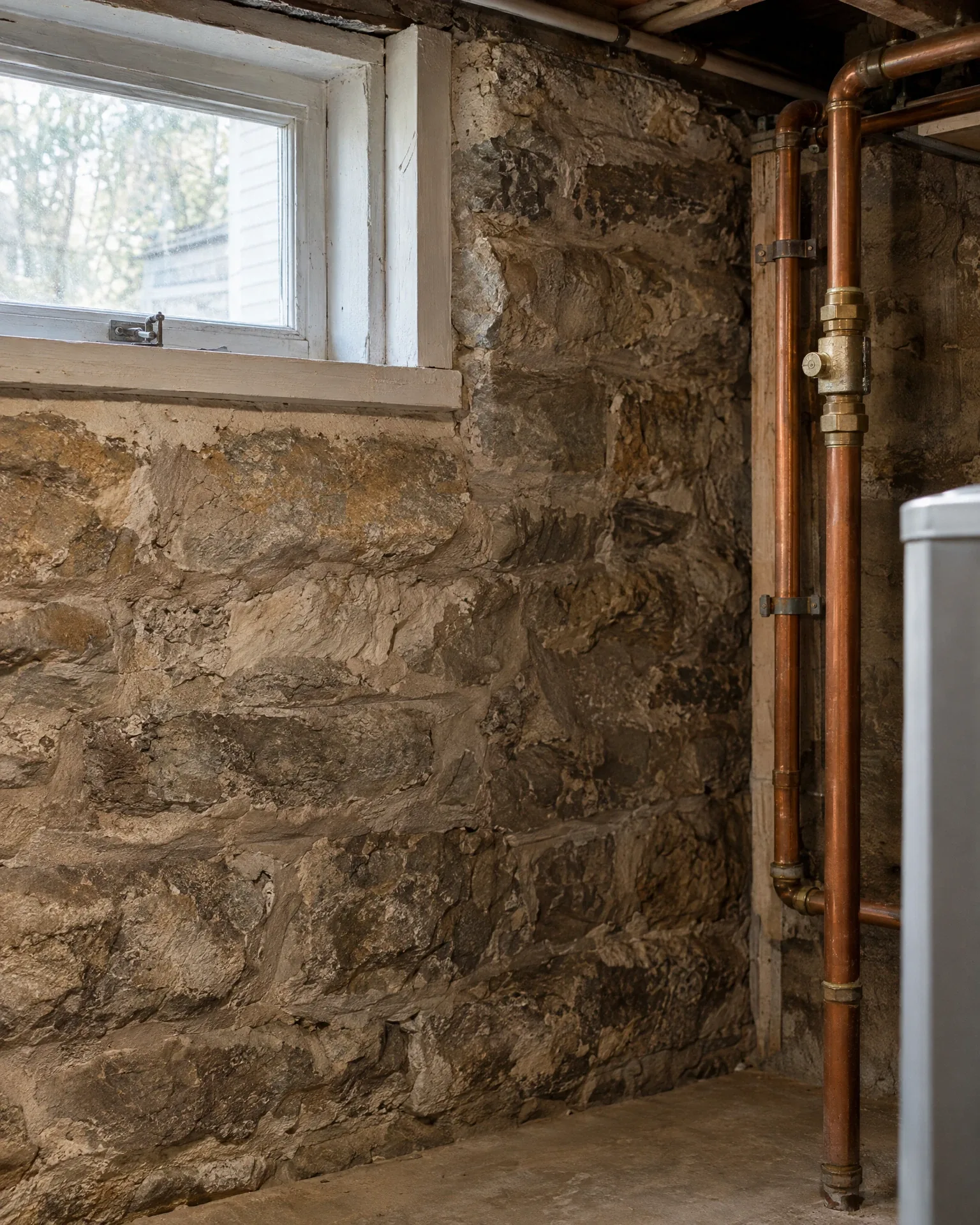
Stone foundation, basement window and copper plumbing in a Northeastern home.
Start with the question
Match a service to a property condition or decision you want to understand.
Plan access
Tell me about the home's systems and arrange access to relevant areas.
Keep findings in context
Each test has a defined scope; results may point to a sensible next step.
Begin with the decision you need to make
Ask what you need to learn beyond a visual inspection. Is the question about radon in indoor air, the quality of a private water supply, or temperature differences that may focus attention? Layout, water source, access, and observations can guide you; none automatically calls for testing. A useful starting point is the decision you hope the information will support.
A general inspection is visual and noninvasive: I assess readily accessible components and describe observed condition and priorities. It is not pass-or-fail and cannot reveal every hidden defect. An add-on examines a defined subject, not everything. I can explain its limits so you can decide whether that information is useful.
Radon: ask about an indoor-air measurement
Radon testing measures concentration under the conditions and period recorded. It answers an indoor-air question a visual walkthrough cannot. As an NRPP Radon Measurement Professional, I conduct radon measurement; the result describes the tested location and conditions, not a health diagnosis or permanent reading for every room and season.
Arrange access and follow my instructions for required testing conditions. Share timing constraints early. Interpret the result with its duration, placement, and conditions in view. If it raises concern, ask what further measurement or qualified follow-up is appropriate; do not stretch one result beyond its scope.
Prepare the property for useful results
Preparation is part of making an additional service worthwhile. Tell me about the areas involved, how the property is occupied, and whether utilities or equipment will be operating. Access to the relevant room, sampling location, or building surface matters. Testing conditions can affect whether a result is useful, so follow the instructions for the specific service rather than apply one set of assumptions to every appointment.
Share any previous results, changes to the water supply, or recent work that relates to your question. If your transaction has a deadline, raise it before scheduling so we can discuss practical timing and any necessary access arrangements. Do not change equipment settings or disturb a test without checking the instructions. Clear preparation helps keep the eventual findings connected to the conditions actually evaluated.
Water: define what a sample should tell you
Water testing helps answer a specific question about the property's supply and a selected analyte. Sampling depends on the source and question. A visual inspection can observe plumbing, but a tap's appearance or odor does not establish water quality. Tell me whether supply is from a private well or public system, what prompted the question, and whether prior results exist.
Analysis covers only selected analytes and the sample, not all contaminants or future conditions. Follow instructions for collection, handling, and timing. If a result calls for action or confirmation, consult a qualified water professional or authority. I can explain scope, but cannot promise a particular outcome.
Read each result with its context
A focused service adds a particular kind of information; it is not a verdict on the entire property. Read what was tested or observed, where the work took place, and the conditions that applied. A radon measurement, a water sample, and a thermal image each have a different meaning. None replaces the broader observations of a general home inspection or establishes that every part of a home is free of concerns.
Use the findings to form a useful next question. Does the result call for confirmation, a change in maintenance, or evaluation by a qualified professional? Keep the report and any test information together so you can refer to them when talking with your advisers. I can explain the scope of the work and the observations; decisions about repairs, treatment, or a transaction belong with you and the relevant specialists.
Thermal imaging: use patterns to guide questions
Thermal imaging shows surface-temperature patterns that may focus inspection. A pattern near a ceiling, wall, or window might prompt questions about air movement, insulation, or moisture. It is not a view through walls. Results depend on temperature differences, weather, building operation, materials, and conditions; a scan may show no useful contrast despite a concern.
Tell me which area or symptom to consider and share relevant history. I interpret images alongside visible conditions, not as a diagnosis. Thermal patterns do not establish the cause of a temperature difference, prove a leak, or find every hidden defect. Further evaluation depends on building conditions and the question you need answered.
Before we take a closer look
Questions worth asking.
Do I need every additional service?
No. Services address different questions. Start with a concern, property feature, or decision needing more information; weigh scope, access needs, and limits. I can discuss what may fit, but you decide what is useful.
Can an add-on tell me the home is problem-free?
No inspection or test can guarantee a defect-free home or establish safety. Each service measures or observes a defined subject under specific conditions. Read findings with those limits and, when appropriate, seek a qualified specialist.
What should I share before scheduling?
Describe your question, conditions or history, system details, and access constraints. Mention the water source, prior test results, indoor-air question, or room of concern. Context helps determine suitability and preparation.
The right scope for your home
Some questions
go a little deeper.
Different services answer different questions. Choose the investigation around the property—not the other way around.
Your next step
Start with your property’s questions.
Unsure which question matters most? Tell me what you have noticed and what you are deciding. I can discuss the relevant service's scope and limits before you choose.